

By Brad Jones, Founder of Tiny Homes of Tucson
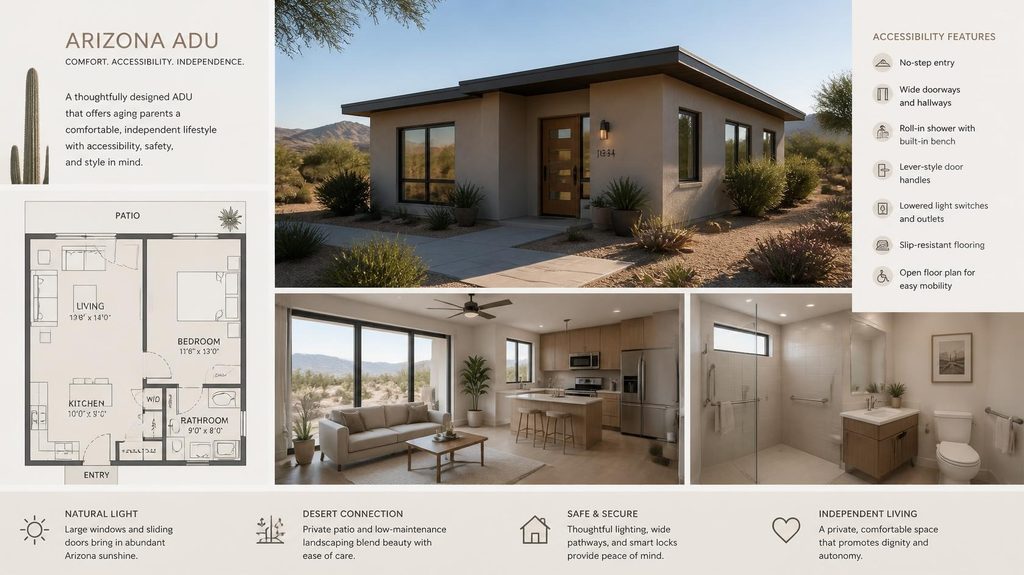
Living in Tucson, we see a situation that probably isn’t nearly as common in other parts of the country.
Mom and Dad live somewhere colder for much of the year. Their adult children and grandchildren live in Tucson. They already spend several weeks or months here every winter, and eventually someone in the family asks a pretty logical question:
Why don’t we just build Mom and Dad a casita in the backyard?
For the right family, I think it’s a great solution.
Instead of buying and maintaining a second home that may sit empty much of the year, or spending thousands of dollars every winter on a seasonal rental, parents can have their own place in Tucson while being just a few steps away from their children and grandchildren.
They can come down when the weather turns cold, stay for three or four months—or longer—and then head home when Tucson starts getting hot.
And as everyone gets older, having family that close can become even more valuable.
But after working with families building casitas throughout the Tucson area, there are a few things I think snowbird families should consider before they start picking floor plans.
First, Make Sure the Property Actually Works
Before deciding whether you want a 600-, 800- or 1,000-square-foot casita, I want to know what we can actually build on the property.
That’s where I think the process should start.
We need to understand the jurisdiction, zoning, setbacks and available building area. We also want to look at things like easements, drainage, utilities, electrical service, sewer or septic, access to the backyard and any HOA restrictions that may apply.
I’ve seen homeowners spend a lot of time looking at floor plans online only to discover that the plan they love doesn’t work particularly well on their property.
I’d rather figure that out first.
Start with the property. Then design the casita around what the property and the family need.
Think About How Much Time You’ll Really Spend in Tucson
There’s a big difference between building a place where you’re going to spend four weeks every winter and building a second home where you may eventually spend five or six months a year.
If you’re going to be here for several months, I think the casita needs to feel like a home, not a guest room.
You probably want a real kitchen.
You want a comfortable living area.
You want enough closet and storage space that you don’t have to live out of a suitcase.
You may want your own washer and dryer.
And you probably want enough separation from the main house that you can enjoy your own routine.
That’s why I spend time asking families how they’re actually going to use the casita before we start talking about the layout.
Being Close to Your Kids Doesn’t Mean Giving Up Your Privacy
This is a big one.
One of the reasons snowbird families like this arrangement is that they can be close to their children and grandchildren.
But close doesn’t have to mean together 24 hours a day.
I think the best multigenerational properties give everyone some independence.
That can influence where we place the casita, which direction the entrance faces, where the windows are located, where everyone parks and whether the casita has its own patio or outdoor living space.
Mom and Dad should be able to have their morning coffee without feeling like they’re sitting in their children’s backyard.
And their kids shouldn’t feel like Mom and Dad moved into the house with them.
Done correctly, you get the best of both worlds.
You’re close enough to be together when you want to be and independent enough to have your own space when you don’t.
Talk About the Money and Ownership Before You Build
This isn’t the most exciting part of the conversation, but it’s important.
If Mom and Dad are spending a significant amount of money to build a casita on property owned by their son or daughter, everyone should understand what that means.
Who is paying for the casita?
Who owns the improvement once it’s built?
Who pays the utilities and ongoing expenses?
What happens if the children eventually sell the property?
What happens if circumstances within the family change?
And what ultimately happens to the casita when Mom and Dad are no longer using it?
There isn’t one answer that’s right for every family.
But there should be an answer.
We’re builders, not attorneys or financial advisors, so there are situations where I encourage families to speak with their attorney, CPA or estate-planning professional before making a substantial investment in someone else’s property.
It’s also worth thinking about the long-term asset value of what you’re building. A well-designed casita can serve the family in more ways than one — we’ve written about how one ADU can serve dual purposes over time, which is worth reading before you make final decisions about the investment.
I’d much rather have those conversations before construction than after it.
If You’re Building at 65, Think About What You’ll Need at 75
This may be the biggest long-term consideration for snowbird families.
You may be completely active and independent today.
Hopefully that doesn’t change.
But if you’re investing this much money into a casita, I think it’s smart to design a home that can work for you now and later.
That doesn’t mean it needs to look like an assisted-living facility.
Aging-in-place features can be incorporated into a beautiful home without being obvious.
We can consider things like a step-free entrance, wider doors, a walk-in or low-threshold shower, blocking in the bathroom walls for future grab bars, good lighting and enough room to comfortably move around.
Most of those decisions are relatively easy to make during design and construction.
They’re considerably more difficult after the home is finished.
My philosophy is pretty simple:
Build for the person you are today, but don’t ignore the person you may be 10 or 15 years from now.
Think About What Happens During the Summer
This is something specifically important for snowbirds in Tucson.
If you’re still deciding whether Tucson is the right fit for your winter plans, our guide on what snowbirds should consider before building a casita covers the lifestyle and financial side in more detail.
If you’re leaving the casita vacant for several months during the hottest part of the year, think about how the home will be maintained while you’re gone.
Someone needs to keep an eye on the HVAC system, plumbing and the general condition of the home.
You’ll probably want smart thermostats and possibly cameras or other remote monitoring.
You’ll need to decide whether you’re leaving internet service active.
You’ll also want to think about landscaping and exterior maintenance.
The good news, of course, is that if your casita is sitting in your children’s backyard, you already have something most snowbirds with a second home don’t have:
Someone you trust living a few steps away.
That’s a significant advantage.
Utilities Can Have a Bigger Impact Than People Expect
Utilities aren’t nearly as much fun to talk about as kitchens and floor plans, but they’re something we pay close attention to early.
Where is the electrical service?
Does it have enough capacity for the additional home?
Where are water and sewer?
Is the property on septic?
How far will we have to trench?
Can the casita use the existing utilities?
These things can materially affect the cost of a project.
They also create another family decision.
If the casita shares utilities with the main house, how will the family handle those expenses while Mom and Dad are in Tucson?
Again, there’s no single right answer.
Just figure it out before it becomes an issue.
Understand What the Project Is Really Going to Cost
This is one area where I believe builders need to be straightforward with people.
There are plenty of advertisements and articles online that make building an ADU sound incredibly inexpensive.
The problem is that the number someone sees online may not include everything required to actually build a permitted, finished casita on their property.
There’s the building itself, but depending on the project there can also be plans, engineering, permits, site preparation, grading, utilities, electrical work, trenching, sewer or septic work and other site-specific expenses.
Arizona’s ADU legislation has made the permitting process more straightforward than it used to be — Arizona’s ADU laws under HB2928 eliminated impact fees on casitas under 1,000 square feet — but every property still has site-specific costs that only a builder walking your land can estimate accurately.
That’s why I don’t think the right question is:
“What’s your price per square foot?”
The better question is:
“What is this casita realistically going to cost on my property?”
That’s the number I want our clients to understand.
At Tiny Homes of Tucson, we’d rather give you a realistic range early and explain what’s included than give you a low number that sounds great and then surprise you later.
Think About the Casita After You Stop Being a Snowbird
There’s another reason I like this concept for families.
The casita can have a useful life long after Mom and Dad stop using it as their winter home.
Maybe one of the parents eventually decides to live in Tucson full time.
Maybe another family member uses it.
Maybe it becomes a place for an adult child.
Maybe it becomes housing for a caregiver.
Depending on the property, jurisdiction and applicable rules, there may be other future uses as well.
The long-term asset value is real. Research from the National Association of Realtors shows that homes with ADUs sell for an average of 35% more than comparable homes without them — which means the casita your parents fund today can meaningfully increase your family’s property value for decades.
That’s why I generally recommend designing a real, functional home rather than something that only works as a seasonal guest room.
You’re not just building for the next winter.
You’re creating another living space on the property that could serve the family for decades.
The Bottom Line for Tucson Homeowners
The national conversation about tiny homes and ADUs is not a trend story about alternative lifestyles. It is a conversation about housing supply, investment returns, and the practical choices available to homeowners who are sitting on valuable land they are not fully using.
The Semafor piece captures the moment accurately. The zoning barriers that made ADU construction impractical in most of the country are coming down. The financing infrastructure is developing, slowly but visibly. And the demand, from renters, from aging parents, from investors looking for yield, is real and growing.
Tucson homeowners are well positioned to act on this. The regulatory environment in Arizona is more favorable than it was three years ago. Home equity levels across the metro are strong. Rental demand remains healthy. And the cost of building a quality ADU, while not trivial, is substantially lower than the value it can generate over a ten or twenty year horizon.
If you have been thinking about whether your property could support an ADU and what it would realistically cost and return, the most useful next step is a property-specific conversation rather than continued general research.
Tiny Homes of Tucson offers free site visits for homeowners across the Tucson area, covering zoning eligibility, design options, and a clear all-inclusive estimate. It is a straightforward way to find out whether your backyard is ready for what the rest of the country is starting to figure out.
My Advice to Snowbird Families: Don’t Start With the Floor Plan
If you’re considering building a casita on your children’s property so you can spend your winters in Tucson, my advice is pretty simple.
Start with the property.
Before you spend months looking at floor plans or deciding what countertops you want, determine what’s actually possible and what it’s realistically going to cost.
That’s where we come in.
At Tiny Homes of Tucson, we’ll meet you and your family at the property. We’ll look at the available space, zoning and setbacks, utilities, access and site conditions. More importantly, we’ll talk about how you actually plan to use the casita.
Then we can start talking about the right size, layout and design.
Sometimes the family’s original idea works perfectly.
Sometimes we find a better location for the casita.
Sometimes we recommend changing the size or layout.
And occasionally we identify an issue that needs to be resolved before the family should move forward.
That’s okay.
Our job isn’t to convince every family we meet that they need to build a casita.
Our job is to help you understand your options, give you realistic information and help you determine whether building one makes sense for your family.
Because when it’s done correctly, I think a casita can be a pretty incredible solution for snowbird families.
You get your own home in Tucson.
Your children and grandchildren are a few steps away.
You don’t have to maintain an entirely separate property across town.
And when everyone wants to spend time together, you’re right there.
But when you’ve had enough family time, you can walk back to your own casita and close the door.
And depending on your family, that last part might be the best feature of all.
─────────────────────────────
Thinking about spending your winters closer to your children or grandchildren in Tucson?
Schedule a complimentary property consultation with Tiny Homes of Tucson. We’ll look at the property with you, talk through what’s possible and give you a realistic idea of what it would take to build a casita that works for your family today and in the years ahead.
Brad Jones
Founder, Tiny Homes of Tucson