

If you have been wintering in Tucson for two, three, or five seasons now, you have probably settled into a rhythm. You know which restaurants stay open in August, which trails are best in January, and which part of town feels most like home when you are not actually home. You have a favorite grocery store. Maybe a regular table somewhere. The question you are quietly starting to ask — if you have not already — is whether it still makes financial and practical sense to rent someone else’s property every winter when you keep coming back to the same city year after year.
That question has a more interesting answer than most seasonal visitors expect. For Tucson homeowners with a qualifying property, the casita model turns the snowbird equation on its head. Instead of paying for someone else’s guest house every November through March, a homeowner builds one on their own property and uses it themselves in winter. In the seven or eight months the owner is not in Tucson, that same unit generates rental income. The structure serves the owner when the owner is here, and generates income when the owner is not. That is a fundamentally different financial arrangement than the rental-only model most snowbirds are currently running.
This article is written for two audiences: Tucson homeowners who have snowbird family members or friends who return each winter and may benefit from having a dedicated guest space on the property, and for seasonal visitors to the Tucson area who are beginning to wonder whether a different kind of arrangement might serve them better over a ten or twenty year horizon.
Why Tucson Has Always Been a Snowbird City
Tucson has drawn winter visitors for more than a century. According to Visit Tucson, snowbirds have been part of Tucson’s identity since the early 20th century, arriving from colder northern states and Canada to spend the mild winter months in the Sonoran Desert. The snowbird season in Tucson runs approximately from October through April, with the heaviest concentration of seasonal visitors arriving in November and December and staying through February or March.
What draws people back year after year is a combination that few other winter destinations can replicate at the same price point. Tucson averages 286 sunny days per year. Winter temperatures regularly reach the mid-60s to low 70s Fahrenheit in the afternoon. The city sits at 2,389 feet of elevation, which moderates the desert heat and gives winter mornings a crisp clarity that visitors from the Northeast or Midwest describe as physically restorative. Saguaro National Park, Sabino Canyon, Mount Lemmon, and more than 50 golf courses are all within easy reach.
Tucson is also significantly more affordable than the other major snowbird markets in Arizona. The same seasonal visitor who would pay $3,500 to $5,000 per month for a short-term rental in Scottsdale can find a comparable or superior arrangement in Tucson for $1,800 to $2,800. For visitors who spend four to five months in Arizona each year, that difference compounds into $5,000 to $10,000 in annual savings — without sacrificing access to the desert climate, the outdoor lifestyle, or the sense of a genuine community.
The Recurring Cost That Never Builds Equity
Here is the financial reality that most long-term snowbirds eventually confront. After five seasons of renting in Tucson at $2,200 per month for five months per year, a seasonal visitor has spent $55,000 on accommodation. After ten seasons, that number reaches $110,000. The money is spent. There is no asset. There is no equity. There is no return on that investment beyond the experience of the winters themselves.
That math is not comfortable when you lay it out plainly. And it becomes less comfortable when you factor in that rental rates for desirable short-term inventory in Tucson have been rising consistently. The seasonal rental market tightens every year as the number of visitors who want to spend winter in Southern Arizona continues to grow, while the supply of quality, well-located seasonal rentals stays relatively fixed. The seasonal visitor who is paying $2,200 this winter may be paying $2,600 or $2,800 for the same unit in three years.
For Tucson homeowners who have regular snowbird visitors — a sibling who comes down every winter, parents who spend three months a year in Tucson, adult children who have discovered they can work remotely and have started timing that remote work around the Arizona winter — this pattern creates a real opportunity. A dedicated casita or guest unit on the property serves the visiting family member in winter, eliminates their rental cost, and generates income during the months they are not in Tucson.
What a Casita Is — and Why the Term Matters in the Southwest
Casita is the Southwestern term for a small, detached guest house on the same property as a primary residence. In the Tucson real estate market, the term is used interchangeably with accessory dwelling unit, though casita carries a specific design connotation: a structure that is architecturally coherent with the main house, typically finished to a higher standard than a purely utilitarian secondary unit, and designed to feel like a genuine home rather than an addition.
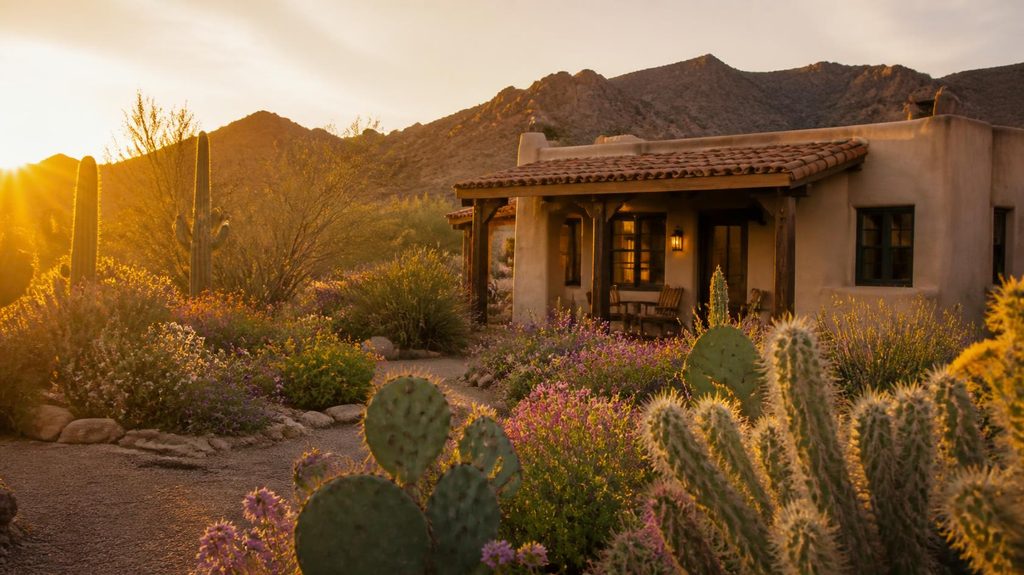
A well-built Tucson casita is typically 400 to 750 square feet. It includes a full kitchen, a private bathroom, a dedicated entrance that does not pass through the main house, and its own outdoor space — a small patio or covered entry area that provides a distinct sense of arrival and privacy. In the Sonoran Desert, design elements like deep overhangs, terracotta or stucco exteriors, and desert landscaping give a casita a coherence with the landscape that generic construction does not achieve.
For a snowbird family member or friend, a casita offers something that a rented unit never fully provides: genuine belonging. The space is theirs for the season. Their things are there year-round. Their preferred coffee is in the kitchen. The garden outside their door is familiar. They arrive in November to a place that feels like their place — not a vacation rental that someone else customized for someone else.
Seven Months of Rental Income While You Are Not Here
For Tucson homeowners who have built or are considering a casita, the months when a visiting family member is not occupying the unit represent a significant income opportunity. Tucson’s short-term rental market has around 4,800 active Airbnb listings and thrives on a mix of university-related travel, snowbird stays, and regional events, according to 2026 data. The city’s balanced demand and lower entry costs relative to Scottsdale or Phoenix make it a strong market for property owners seeking consistent bookings rather than headline nightly rates.
A well-designed, well-positioned casita in Tucson’s established neighborhoods can generate $1,200 to $1,800 per month on the long-term rental market or $1,500 to $2,200 per month through short-term platforms during peak season. The snowbird season itself — October through April — is Tucson’s strongest period for short-term rental demand, with occupancy rates and nightly rates at their annual highs. A homeowner who occupies the casita personally from November through March and rents it during the remaining seven months captures income precisely when the market most wants to offer it.
It is worth understanding the income potential in context of the full financial picture. For homeowners evaluating whether a casita generates meaningful rental income in Tucson and what factors most influence that return, the key variables are location within the metro, proximity to the University of Arizona and major employers, finish level, and whether the unit is designed for the full-kitchen, private-entrance standard that commands top-of-market rents.
What to Think Through Before Building a Casita for Winter Use
The casita model works best for a specific type of situation. It is worth being clear about what that situation looks like before going further.
- A family member or close friend returns to Tucson every winter for at least two to three months. The casita earns its keep most quickly when the winter occupant is someone whose annual return is reliable and whose presence eliminates what would otherwise be a recurring seasonal rental expense. A visitor who comes once every few years does not create the same financial logic as someone who has wintered in Tucson for the past decade and intends to continue.
- The Tucson property has a qualifying lot. A casita is a permitted structure, which means the lot needs to support the setbacks, coverage limits, and access requirements that Tucson’s zoning code establishes for secondary units. Some properties are well-suited. Others are constrained by lot size, existing structures, or utilities. A property-specific site visit is the only way to know for certain what your lot can support.
- The homeowner is willing to manage or arrange management of short-term rentals. A casita that sits empty for seven months generates no income. The income opportunity requires either direct management through a platform like Airbnb or VRBO, or a relationship with a local property management company that handles the turnover, guest communication, and maintenance coordination on the owner’s behalf. This is not a passive income arrangement without some operational structure behind it.
- The financial case clears on a ten-year horizon. A quality casita build in Tucson typically runs $130,000 to $200,000 all-in for a detached unit. At $1,400 per month in net rental income across seven rental months per year, the unit generates $9,800 annually in the off-season. The winter accommodation value, measured against what a visiting family member would otherwise pay in seasonal rentals, adds another $8,000 to $12,000 in avoided cost per year. Combined, the unit is recovering $18,000 to $22,000 annually in real financial value, placing the payback window at roughly seven to ten years before the property value appreciation is factored in at all.
A Note for Families With Aging Snowbird Parents
For Tucson homeowners whose parents are among the seasonal visitors, the casita conversation often happens in parallel with a longer-term planning conversation. A parent who currently winters in Tucson in a rental unit and is managing their own independent travel is typically in their late 60s or early 70s. Within five to ten years, that independence may require more support infrastructure than a short-term rental arrangement can provide. When Tucson families compare an ADU or casita to the actual cost and experience of assisted living in Southern Arizona, the financial and personal case for a dedicated family structure shifts considerably.
A casita built today for a parent who winters independently in Tucson can evolve, over the course of the same decade, into a permanent residence that keeps that parent close, safe, and independent without the cost and separation of a care facility. The structure does not change. The purpose deepens. The families who build early, while the decision is proactive rather than reactive, consistently report that the timing was the single most important variable in how well the arrangement worked for everyone involved.
Design Considerations Specific to Seasonal Use
A casita designed for seasonal snowbird use has a few specific requirements that differ from a unit designed purely for year-round rental or permanent family occupancy.
Storage for the owner’s belongings. A seasonal visitor does not want to pack and unpack every year. Dedicated, lockable storage within or adjacent to the casita unit allows the winter occupant to leave their preferred items in place between visits. This is a feature that renters during the off-season do not need access to and that can be cleanly separated within the unit’s footprint.
Climate control that handles both seasonal extremes. Tucson’s summer heat reaches temperatures that require serious cooling capacity. A ductless mini-split system sized for the unit’s square footage, combined with proper insulation and shading, keeps summer utility costs manageable during the months the unit is rented and ensures the casita is comfortable when the owner arrives in fall.
Desert landscaping that is low-maintenance year-round. A casita owner who is in Tucson only for the winter needs a landscape that does not require regular attention in their absence. Native desert plantings, decomposed granite groundcover, and a drip irrigation system that operates on a timer provide a maintained, attractive exterior without requiring an ongoing maintenance contract.
A separate entrance and distinct outdoor space. For a winter visitor, the sense of having their own place is as important as any interior feature. A defined entrance pathway, a private patio or covered seating area, and clear visual separation from the main house’s outdoor space give the casita occupant the psychological experience of arriving at their own home rather than a guest room.
The Practical First Step
If you are a Tucson homeowner who has snowbird family or friends returning each winter, or if you have been wintering in Tucson and are beginning to ask whether a different kind of arrangement might serve you better financially, the most useful first step is a property-specific assessment rather than more general research.
Every lot is different. Setbacks, existing structures, utility connections, and zoning district all affect what is possible, what it costs, and how quickly a casita build would pencil out financially for your specific situation. A conversation with a builder who specializes in Tucson ADU and casita construction is the only way to move from a general idea to a real plan with real numbers.
Tucson Tiny Homes offers free site visits for homeowners across the metro area. We walk your property, assess exactly what your lot can support, discuss design options appropriate for seasonal and dual-use occupancy, and provide a clear, all-inclusive estimate with no vague ranges and no hidden fees. It is the fastest way to answer the question that every snowbird’s family member eventually starts asking: what would it look like if we stopped renting someone else’s casita and built one that actually belongs to us?
The Bottom Line for Tucson Homeowners
If you’ve made it this far, you already understand something most homeowners don’t…
An ADU isn’t just a “nice-to-have” project. It’s a strategic move.
It’s how you create space without leaving your neighborhood.
It’s how you take care of family without sacrificing privacy.
And for a lot of people right now, it’s how you turn your property into something that actually works for you instead of just sitting there.
But here’s the part that trips most folks up…
All the rules, permits, zoning, and costs can feel like a mess if you try to figure it out on your own. And as you’ve seen, there are a lot of moving pieces involved, from zoning restrictions to utility connections to financing options .
That’s exactly why working with a local team matters.
Someone who already understands Tucson’s regulations.
Someone who knows what flies with permits and what gets rejected.
Someone who can look at your property and give you a straight answer instead of a guess.
👉 That’s where Tiny Homes of Tucson comes in.
They don’t just build ADUs. They help you navigate the entire process, from idea to move-in, without the usual headaches.
So instead of spending months second-guessing everything…
You can actually move forward with a plan that makes sense.
If you’re even thinking about adding an ADU, the smartest next step isn’t more research.
It’s getting clearer.
Talk to a team that’s already done this before, right here in Tucson.