

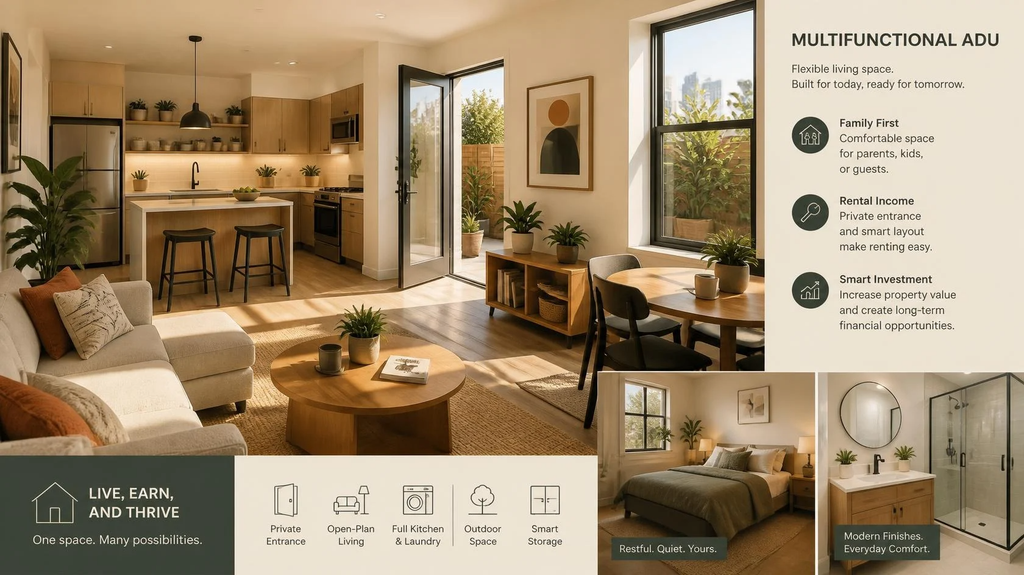
Most homeowners who start thinking about an ADU come in through one door. They either need a space for a parent or adult child right now, or they are drawn to the idea of generating rental income from land they already own. What they often do not realize until someone lays it out clearly is that these two purposes are not competing alternatives. They are two chapters of the same asset.
A well-built accessory dwelling unit on a Tucson property can serve your family today and serve your financial goals tomorrow. That flexibility is not an accident or a nice coincidence. It is, when designed correctly from the start, the single most compelling argument for why an ADU is one of the strongest long-term decisions a homeowner can make.
This piece is for the Tucson homeowner who is weighing both options and is not sure which one is the right entry point or whether they need to choose at all.
Understanding the Two-Phase Logic
Think of an ADU as a structure with a lifecycle rather than a fixed function. In Phase One, it solves an immediate family need. A parent who needs to be nearby but still wants independence. An adult child returning home from college who needs their own space. A sibling or in-law staying for an extended period while navigating a life transition. These are real, present-tense problems that cost real money and real emotional bandwidth when left unsolved.
In Phase Two, once the immediate family need has passed or changed, that same unit transitions into a rental asset. The private entrance, the full kitchen, the separate utility connections that made it ideal for a family member are exactly the features that make it attractive to a long-term tenant or short-term rental guest. The structure does not change. The purpose does.
This is not a theoretical framework. It is the actual pattern that plays out for a significant share of the homeowners we work with in Tucson. They build for family first. Then the parent passes or the adult child moves on, and rather than sitting on an empty structure, they activate the rental potential they built in from day one.
Phase One: Why ADUs Work for Multigenerational Living
The multigenerational case for an ADU is both financial and emotional. On the emotional side, there is something that assisted living cannot offer: proximity without intrusion. A parent who lives in a backyard ADU has their own front door, their own kitchen, their own morning routine, and their own sense of daily independence. You are sixty seconds away when something goes wrong. Nobody has to give up anything to make that possible.
The financial comparison is equally stark. When you weigh an ADU against assisted living costs for Southern Arizona families, the numbers shift the conversation quickly. Assisted living in the Tucson area currently runs $4,500 to $6,500 per month depending on the level of care required. Over three years, that is $162,000 to $234,000, paid to a facility your family member did not choose to live in, for care delivered by strangers in an environment designed for institutional efficiency rather than dignity or personal comfort.
An ADU on your Tucson property is a one-time capital investment that your family owns permanently. It does not generate a monthly bill. It generates a permanent asset. The parent or family member who lives there maintains their independence, maintains their familiar surroundings, and maintains proximity to the people who matter to them. That combination is not available at any price in the traditional elder care system.
From a design perspective, an ADU built with Phase One in mind incorporates a few features that matter significantly for aging-in-place occupancy: wider doorways that accommodate mobility aids, a step-free entrance, grab bar blocking in bathroom walls, and a single-story layout that eliminates stair-related risk. These features do not add substantially to the cost of construction. They add enormously to the suitability of the space for an older occupant — and, as we will see, they do not diminish the unit’s rental appeal in any meaningful way when Phase Two arrives.
Phase Two: Activating the Rental Potential
When the immediate family need has resolved and the question becomes what to do with the unit, Tucson’s rental market offers strong answers for ADU owners considering income generation. A well-designed detached ADU in the Tucson metro area commands $1,000 to $1,500 per month on the long-term rental market, depending on location, size, and finish level. On short-term platforms like Airbnb and VRBO, well-positioned units with strong design appeal can generate meaningfully more, particularly during Tucson’s peak tourism and university seasons.
The features that made the unit ideal for a family member translate directly into rental appeal. A private entrance, a full kitchen, a dedicated bathroom, and independent utility connections are the exact features that distinguish a rentable ADU from an oversized storage shed. Tenants — whether long-term or short-term — want the same things your parent or adult child wanted: privacy, functionality, and a space that feels like a real home rather than an afterthought.
At the federal level, regulatory changes have been strengthening the financial case for ADU rental income. The Federal Housing Administration now allows 75 percent of documented ADU rental income to be counted as qualifying income for mortgage underwriting. Freddie Mac explicitly states that rental income from ADUs can be used as qualifying income when certain requirements are met, and has done so since expanding its ADU policy in 2022. As recently as March 2026, the USDA Rural Housing Service proposed rule changes that would allow ADU income to be factored into guaranteed loan program underwriting. These are not fringe financial instruments. They are mainstream federal programs beginning to formally recognize what ADU owners in Tucson already know from experience: rental income from a backyard unit is real, documentable income that lenders and appraisers are increasingly equipped to value correctly.
The Design Decisions That Make Both Phases Work
The two-phase strategy only works if the ADU is designed from the beginning with both phases in mind. An ADU that is optimized purely for family occupancy may be difficult to adapt for the rental market later. An ADU designed purely for short-term rental appeal may lack the accessibility features and privacy design that makes it genuinely livable for an older family member. The solution is a design philosophy that treats both purposes as simultaneous requirements rather than trade-offs.
Here are the specific design choices that preserve full flexibility across both phases:
• Separate entrance that does not pass through the main house. This is non-negotiable for both phases. A parent needs it for independence. A tenant requires it for privacy. Any ADU design that lacks a fully independent entrance is limiting its own potential from day one.
• Full kitchen, not a kitchenette. A full-size refrigerator, a range or cooktop, and adequate counter space are the difference between a space that functions as a real home and one that functions as an extended stay room. This matters equally to a family occupant and to a rental tenant comparing options in a competitive market.
• Accessible bathroom design. A walk-in shower with a fold-down bench, grab bar blocking in walls, and a wider door clearance adds minimal cost during initial construction and adds nothing that a younger tenant would object to. It is, at worst, invisible to someone who does not need it and essential for someone who does.
• Independent utility metering where possible. A separately metered unit allows a rental tenant to manage their own utility consumption rather than sharing a bill with the primary household. This is a feature that experienced landlords consistently report improves tenant quality and simplifies the landlord relationship.
• Outdoor privacy design. A dedicated outdoor space for the ADU — a small patio, a defined entry area, desert landscaping that creates visual separation from the main house — serves the same purpose in both phases. A parent wants to sit outside without feeling they are in the main household’s backyard. A tenant wants the same.
• Single-story layout. A ground-floor unit eliminates stair-related barriers for an older occupant and is also the most desirable configuration for the broadest range of rental tenants, including those with mobility considerations, families with young children, and guests on short-term platforms who are visiting Tucson for medical appointments or university events.
The Financial Architecture of a Two-Phase ADU
The full financial picture of a two-phase ADU builds across time in a way that a purely family-use analysis understates.
In Phase One, the financial return is primarily measured as cost avoidance. If the alternative to your family ADU is a care facility at $5,000 per month, then every month a family member lives in your ADU represents $5,000 in avoided cost. Over three years, that is $180,000 in cost that was not incurred. The ADU build cost typically $130,000 to $200,000 for a quality detached unit in Tucson is largely or fully offset by the care costs it replaced, and the homeowner retains a permanent asset rather than a stack of paid invoices.
In Phase Two, the financial return shifts to active income. At $1,200 per month in net rental income, a Tucson ADU generates $14,400 per year. Over a ten-year rental period, that is $144,000 in income from an asset that already paid for itself in Phase One. The compounding effect of owning an income-producing structure on land you already own, with no additional land cost, no separate mortgage, and no absentee landlord arrangement, is what makes the two-phase ADU a uniquely efficient investment vehicle for a Tucson homeowner with a qualifying property.
Property value appreciation runs in the background throughout both phases. Research consistently places the appraised value uplift from a permitted, quality-built ADU at 20 to 35 percent of the primary home’s value, depending on design, location, and market conditions. In a Tucson market where home values have appreciated meaningfully over the past decade, that uplift represents real equity that is available at refinance or resale.
What This Means If You Are Thinking About an ADU Now
If you are a Tucson homeowner who currently has a family member who needs nearby housing, or who anticipates that need in the next few years, the two-phase ADU model changes the financial calculation in your favor in a specific way: it removes the pressure to choose between family use and investment return.
You do not have to decide today whether you are building a family space or a rental unit. You are building a structure that is good enough and flexible enough to be both, in sequence, on the same property you already own. The upfront design work that makes both phases possible adds relatively little to the construction cost and adds enormously to the long-term utility of the asset.
The most important first step is understanding whether your specific property can support a quality ADU build and what the all-inclusive cost looks like for a unit designed with both phases in mind. That answer is property-specific. It depends on your lot size, your zoning district, your setbacks, and your existing utility connections. It cannot be answered by a website or a general cost guide.
Tucson Tiny Homes offers a free site visit for homeowners across the Tucson metro area. We walk your property, assess what your lot can support, discuss design options that preserve both family-use and rental-use flexibility, and provide a clear, all-inclusive estimate with no vague ranges and no hidden fees. It is the fastest way to replace general information with a real plan built for your specific property and your specific family’s timeline.
The two-phase ADU is not a compromise between two good ideas. It is the realization that both ideas lead to the same well-designed structure and that the families who build it rarely regret having done so on either timeline.
The Bottom Line for Tucson Homeowners
If you’ve made it this far, you already understand something most homeowners don’t…
An ADU isn’t just a “nice-to-have” project. It’s a strategic move.
It’s how you create space without leaving your neighborhood.
It’s how you take care of family without sacrificing privacy.
And for a lot of people right now, it’s how you turn your property into something that actually works for you instead of just sitting there.
But here’s the part that trips most folks up…
All the rules, permits, zoning, and costs can feel like a mess if you try to figure it out on your own. And as you’ve seen, there are a lot of moving pieces involved, from zoning restrictions to utility connections to financing options .
That’s exactly why working with a local team matters.
Someone who already understands Tucson’s regulations.
Someone who knows what flies with permits and what gets rejected.
Someone who can look at your property and give you a straight answer instead of a guess.
👉 That’s where Tiny Homes of Tucson comes in.
They don’t just build ADUs. They help you navigate the entire process, from idea to move-in, without the usual headaches.
So instead of spending months second-guessing everything…
You can actually move forward with a plan that makes sense.
If you’re even thinking about adding an ADU, the smartest next step isn’t more research.
It’s getting clearer.
Talk to a team that’s already done this before, right here in Tucson.