

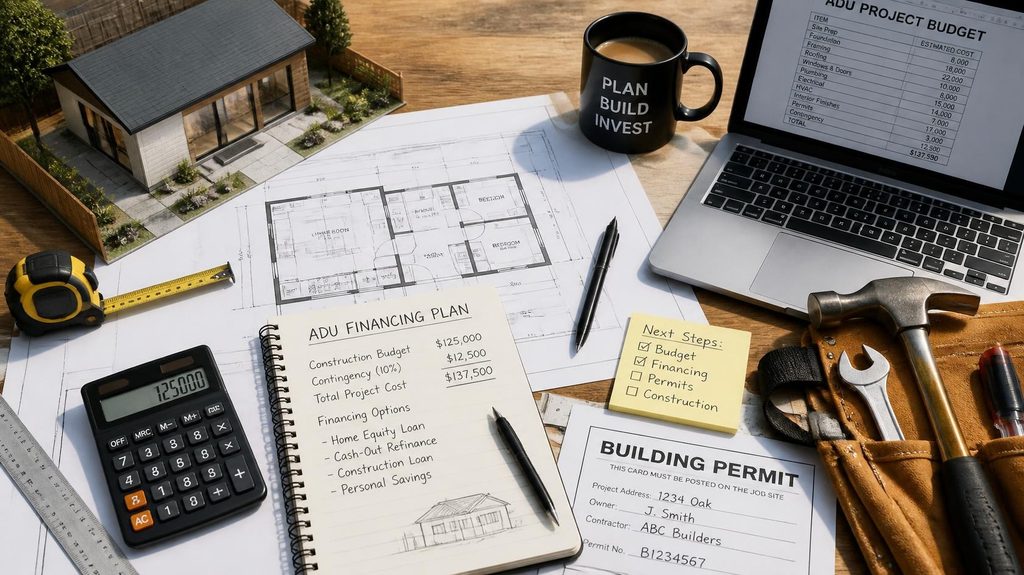
Building an accessory dwelling unit in Tucson is a major financial decision. A well-designed casita can give your family more flexibility, create long-term rental income, and add usable value to your property for years to come.
But before choosing a floor plan or finish package, there is a more basic question to answer:
How are you going to pay for it?
Fortunately, Tucson homeowners have several financing options available, ranging from traditional home-equity products to renovation loans that can account for the value of the completed project.
The right choice depends on your current mortgage, the amount of equity you have, your income, your plans for the ADU, and how much you want to borrow.
This guide explains the most common ways Tucson homeowners finance an ADU and what to consider before choosing one.
Important: Tiny Homes of Tucson is a residential construction company, not a mortgage lender or financial advisor. Loan programs, underwriting standards, rates and tax consequences can change. Always confirm current requirements with a qualified lender or financial professional.
Why Financing an ADU Is Different From Financing a Typical Remodel
An ADU is more than a cosmetic improvement.
You are creating an additional permitted living space on your property, often with its own kitchen, bathroom, HVAC, utilities and private entrance. Depending on the project, that new structure may provide housing for family members, serve as a long-term rental, or simply increase the functionality and desirability of the property.
Because of that, some lenders are willing to evaluate an ADU based not only on the property as it exists today, but also on its expected value after construction is complete.
That distinction can make certain renovation and construction loan products particularly useful for ADU projects.
The cost of a site-built casita varies considerably based on size, site conditions, utilities, access, jurisdiction, architecture and finish level. That is why financing and project budgeting should be discussed early rather than after plans are already complete.
Option 1: Home Equity Loan
A home equity loan allows you to borrow against equity you have already accumulated in your home.
You typically receive the loan proceeds as a lump sum and repay the balance over a fixed period, generally with a fixed interest rate.
For homeowners who have owned their Tucson property for several years and have substantial equity, this can be one of the simplest ways to finance an ADU.
The advantages are straightforward:
- predictable monthly payments,
- a fixed interest rate in many cases,
- no need to refinance your existing first mortgage,
- and a clear amount available for construction.
The primary limitation is that the loan is based largely on the equity you already have.
A lender will typically limit the combined amount of your existing mortgage and home-equity debt to a certain percentage of the property’s value. The exact percentage varies by lender, borrower qualifications and loan program.
For homeowners with significant equity and a favorable existing mortgage, a home equity loan can be particularly attractive.
Option 2: Home Equity Line of Credit — HELOC
A HELOC also uses the equity in your property, but it operates more like a revolving line of credit.
Rather than receiving all of the money upfront, you can draw funds as they are needed.
That can work well with construction because ADU expenses occur over time rather than on a single day.
For example, a homeowner may draw funds as construction reaches milestones such as foundation, framing, mechanical work and finishes.
One potential benefit is that you generally pay interest only on the money you have actually borrowed.
The biggest consideration is that HELOC interest rates are often variable.
That means your borrowing cost and monthly payment could increase if market rates rise.
Before relying on a HELOC, homeowners should understand both the current payment and what the payment could look like if rates move higher.
Option 3: Combine Cash With Home Equity
ADU financing does not have to be all-or-nothing.
Some homeowners use a combination of cash and financing.
For example, a homeowner might contribute a portion of the project cost from savings and finance the remaining balance through a HELOC or home equity loan.
That approach can be especially attractive for homeowners who already have a low-interest first mortgage that they do not want to disturb.
Using some cash can:
- reduce the amount borrowed,
- lower monthly payments,
- reduce total interest expense,
- and potentially improve financing flexibility.
At the same time, homeowners should avoid putting so much cash into construction that they leave themselves without adequate emergency reserves.
The right balance depends on the household’s overall financial situation.
Option 4: Cash-Out Refinance
A cash-out refinance replaces your existing mortgage with a new, larger mortgage.
The difference between the old loan balance and the new loan amount is provided to you in cash and can be used toward the ADU.
This can make sense in certain situations, particularly when the homeowner has substantial equity or when the new mortgage terms are attractive.
However, homeowners with older mortgages at very low rates need to evaluate this carefully.
Refinancing a large existing mortgage simply to access ADU construction funds can mean replacing an attractive interest rate with a significantly higher one on the entire balance.
That is why it is important to compare the total cost of a refinance against alternatives such as a HELOC or home equity loan.
Option 5: Fannie Mae HomeStyle Renovation Loan
The Fannie Mae HomeStyle Renovation program can be an important option for homeowners considering an ADU.
Fannie Mae specifically allows HomeStyle Renovation financing to be used to construct an ADU as part of an eligible renovation transaction.
Instead of relying only on the value of the home as it exists today, renovation financing can incorporate the planned improvements into the underwriting and appraisal process.
That can be useful for homeowners who do not currently have enough equity to finance the entire project through a traditional home-equity product.
HomeStyle financing is generally more structured than a HELOC.
The lender will typically require detailed plans, contractor documentation, budgets, construction draws and inspections before funds are released.
That added process can take more time, but it may provide additional borrowing flexibility for the right homeowner.
What about ADU rental income?
Fannie Mae has expanded the circumstances under which income from an ADU may be used when qualifying for a mortgage.
Current guidance allows ADU rental income to be considered in certain situations involving a one-unit principal residence, subject to transaction-specific restrictions. The amount of ADU rental income used for qualifying is also capped at 30% of the borrower’s total qualifying income.
This does not mean every borrower can automatically use projected future rent from an ADU that has not yet been constructed.
If rental income is important to your ability to qualify, ask the lender specifically how its underwriting applies to the property and loan program you are considering.
Option 6: Construction-to-Permanent Financing
Construction-to-permanent financing combines construction financing and long-term mortgage financing into one structure.
During construction, funds are typically released through a series of draws.
After construction is completed, the loan converts into permanent financing.
Fannie Mae specifically recognizes construction-to-permanent financing as one potential way to finance a new one-unit home that includes an ADU.
For an ADU being added to an existing residence, product availability varies considerably by lender.
These loans generally require:
- plans and specifications,
- detailed construction budgets,
- an approved contractor,
- inspections,
- draw administration,
- and lender approval of the project.
Not every lender offers construction financing for standalone ADU projects, so homeowners may need to speak with several lenders.
Questions to Ask a Lender Before Financing an ADU
The name of the loan matters less than understanding exactly how the lender will treat your project.
Here are some of the most important questions to ask:
- Will the appraisal consider the completed value of the ADU?
- How much equity or down payment will I need?
- Are the funds released upfront or through construction draws?
- What inspections are required before each draw?
- Does the lender have specific contractor requirements?
- Can ADU rental income be considered in qualification?
- How will the loan affect my existing first mortgage?
- Are there closing costs, origination fees or draw fees?
- Is the rate fixed or variable?
- What happens if construction costs exceed the original budget?
A lender with experience financing ADUs or residential construction should be able to explain these issues clearly before you commit.
What About Rental Income?
For some homeowners, rental income is an important part of the financial rationale for building an ADU.
A detached casita can potentially generate income while also creating an asset that remains part of the property.
Actual rent depends heavily on:
- neighborhood,
- square footage,
- number of bedrooms,
- parking,
- privacy,
- furnishings,
- utilities,
- condition,
- and whether the property is rented long term or seasonally.
Rather than assuming a particular rental number, homeowners should look at comparable rentals in their immediate area and build a conservative projection.
If your financing depends on rental income, it is especially important to distinguish between:
what the property may realistically rent for
and
what the lender is actually willing to count toward qualification.
Those are not necessarily the same number.
Seasonal and Short-Term Rental Considerations
Tucson’s winter visitor market can make furnished casitas attractive for some homeowners.
However, short-term rental rules differ from long-term rental rules and can involve state law, local requirements, HOA restrictions and insurance considerations.
Arizona’s ADU legislation protects long-term rental use in certain municipalities, but private restrictive covenants can still affect how an ADU may be used.
If rental income is part of the plan, verify the rules that apply to the specific property rather than assuming every ADU can be operated the same way.
Arizona Has Become More ADU-Friendly
Arizona has made meaningful changes to ADU law in recent years.
Under HB 2720, municipalities with populations above 75,000 are required to allow ADUs on qualifying properties where single-family homes are permitted. The law also limits several types of local restrictions, including rear and side ADU setbacks greater than five feet in covered municipalities.
That has created considerably more certainty for homeowners than existed several years ago.
But it does not mean every property can automatically accommodate every ADU.
Individual projects may still be affected by:
- zoning,
- lot configuration,
- easements,
- floodplain conditions,
- septic capacity,
- utilities,
- building and fire codes,
- airport-related restrictions,
- and private HOA requirements.
Arizona law expressly allows private restrictive covenants concerning ADUs to remain relevant.
That is why property-specific feasibility work should come before final design and financing decisions.
How Can an ADU Affect Property Taxes?
Adding permitted living space can affect the assessed value of your property.
Arizona’s Proposition 117 generally limits annual growth in Limited Property Value to 5% under the standard calculation, but different valuation rules can apply when a property experiences physical changes such as new construction.
Because an ADU is a significant physical improvement, homeowners should not simply assume their tax increase will be limited to 5%.
The Pima County Assessor or a qualified tax professional can provide guidance based on the specific property and project.
Financing Should Come Before Final Design
One of the most common mistakes homeowners can make is designing the ADU they want before determining what they are comfortable spending.
The better process is:
Property feasibility → realistic project budget → financing strategy → design
Knowing your financial range early affects:
- square footage,
- bedroom count,
- finish level,
- patios,
- site work,
- utility choices,
- and optional upgrades.
It also helps prevent spending time designing a project that ultimately does not fit the household’s financial goals.
The Right Financing Option Depends on the Homeowner
There is no single “best” ADU loan.
For one homeowner, the right answer may be a HELOC because they have substantial equity and a low-rate first mortgage they want to keep.
Another homeowner may prefer a fixed-rate home equity loan.
Someone else may benefit from renovation financing that considers the completed project.
And some homeowners may decide that a combination of cash and financing gives them the best balance between monthly payment and liquidity.
The important thing is to evaluate the financing strategy alongside the actual cost of the project.
Start With the Property
Before speaking with a lender about a hypothetical $100,000, $150,000 or $200,000 project, it helps to know what your property can actually support and what the project you want is likely to cost.
Tiny Homes of Tucson offers complimentary property consultations throughout the Tucson area.
We can help you understand:
- what your property may be able to accommodate,
- potential zoning and setback considerations,
- HOA issues,
- possible casita locations,
- design options,
- site and utility concerns,
- and a realistic preliminary project budget.
That gives you a much more useful number to take into a financing conversation.
Schedule a complimentary property consultation with Tiny Homes of Tucson.
You can also visit our financing resource page to learn more about financing options and lenders familiar with residential construction.
A successful ADU project is not necessarily the cheapest one or the largest one.
It is the project that fits the property, serves the family’s needs, and is supported by a financing structure the homeowner can comfortably manage.