

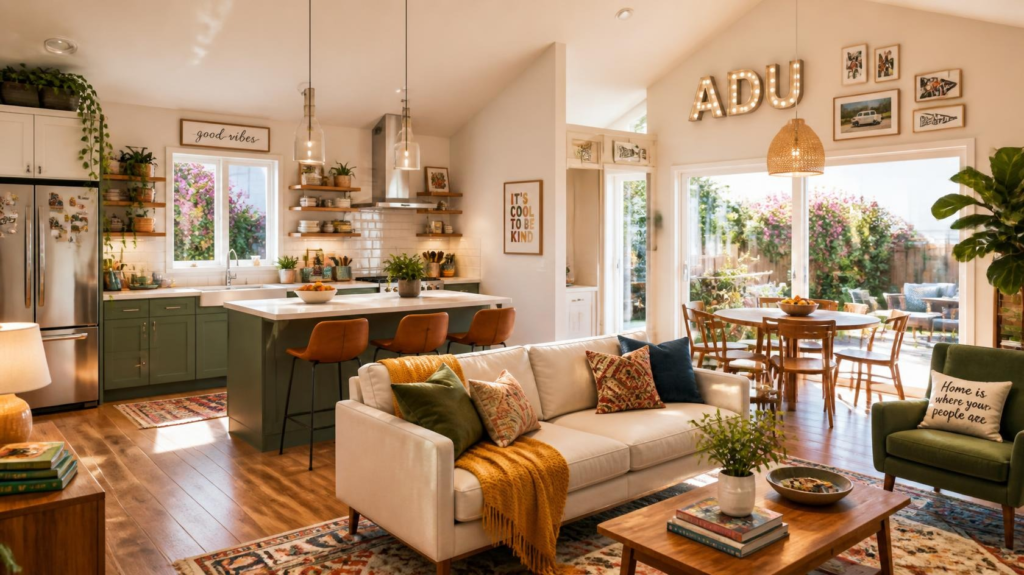
If your household has quietly turned into a full house — an aging parent who needs a little extra support, an adult child who’s back in their old bedroom, or both — you’re not alone. Across Tucson and Southern Arizona, more families are solving space, privacy, and caregiving challenges the same way: by building an Accessory Dwelling Unit (ADU) in the backyard instead of remodeling, renting, or moving.
The tricky part is knowing when it’s time to stop weighing the idea and start planning. Below are five signs that tell Tucson homeowners it’s the right moment to build an ADU — plus what to consider before you break ground.
1. Your Home Has Turned Into a Revolving Door of Family Members
If you’ve stopped being “empty nesters” and started hosting a full house again, you’re part of a fast-growing national trend. According to Thrivent’s 2026 Boomerang Kids Survey, 44% of U.S. parents with adult children ages 18–35 say a child has moved back home at some point — a number that’s held steady for three years running, driven largely by housing costs and student debt. On the other end of the household, a growing share of homeowners are also welcoming aging parents back under one roof, or planning to.
When two generations are sharing one bathroom, one kitchen, and one living room, tension builds fast — even in families that love each other dearly. An ADU solves this by giving everyone a private front door while keeping the family close. It’s the difference between “living on top of each other” and “living next door to the people you love.”
The sign: More than one adult generation is regularly sharing your main house, and it’s starting to strain daily routines, privacy, or relationships.
2. You’re Worried About an Aging Parent Living Alone — But Assisted Living Feels Like Overkill
Most older adults don’t want to leave their community, and many don’t need (or want) a full assisted living facility — they just need to not be alone. Research from AARP’s Home and Community Preferences Survey found that roughly three-quarters of adults 50 and older want to remain in their own homes and communities for as long as possible, and a majority say it’s important that their community offer a range of housing options as their needs change. At the same time, the Pew Charitable Trusts notes that very few U.S. homes are actually built to support aging in place, which is part of why ADUs — purpose-built, single-story, accessible units — have become such a popular middle ground between “stay in a house that doesn’t fit their needs” and “move into a facility.”
An ADU lets an aging parent keep their independence and routine while living just steps from family who can check in, help with meals, or respond quickly in an emergency. It’s often described as “independent togetherness” — separate walls, shared peace of mind.
If you’re actively comparing an ADU to a nursing home or assisted living community for a parent, our detailed breakdown, ADU vs. Assisted Living: What Southern Arizona Families Should Compare, walks through cost, care level, and lifestyle differences side by side.
The sign: You’re losing sleep over a parent living alone, but a full-time care facility feels premature, too expensive, or like it would take away their independence.
3. The Math on Assisted Living or a Second Mortgage Isn’t Adding Up
Assisted living and memory care in Arizona routinely run into the thousands of dollars per month — costs that recur for years and build zero equity. Renting a second property for an adult child, or helping cover their rent elsewhere, comes with the same problem: money spent, nothing built.
An ADU flips that equation. It’s a one-time construction investment that adds real, appraised value to your property, and it can even generate income later — as a short-term rental, a long-term rental, or simply a way to reduce what you’re spending on outside care. Multiple industry analyses point out that ADUs can lower caregiver costs, increase property value, and in some jurisdictions qualify for local tax incentives tied to multigenerational or elder-care housing.
The sign: You’ve priced out assisted living, in-home care, or a second household — and the ongoing costs make a one-time backyard build start to look like the smarter long-term investment.
4. You Keep Saying “We’ll Figure It Out When the Time Comes”
This is the sign that’s easiest to miss, because it doesn’t feel urgent — until suddenly it is. Waiting until there’s a health scare, a lease ending in 30 days, or a sudden need for support often means scrambling for the fastest option instead of the best one, which usually means a rushed decision, a facility with an opening, or a stressful short-term rental.
Building an ADU takes planning: zoning research, permitting, design, and construction all take time. Families who start the process before there’s an emergency get to make thoughtful choices about layout, accessibility features, and budget — instead of reactive ones. If “we’ll figure it out later” has become your family’s unofficial plan, that’s actually a strong signal to start the ADU conversation now, while you have the luxury of time.
The sign: You’ve had the conversation about a parent’s future care, or a child’s next housing move, more than once — but nothing has actually moved forward.
5. Your Property Has Room, But Your House Doesn’t
Sometimes the issue isn’t family dynamics at all — it’s square footage. Many Tucson lots have plenty of usable backyard space, but the house itself is maxed out: three bedrooms, one bathroom, and no realistic way to add a suite without a full-scale, expensive addition.
In that scenario, building outward — with a detached ADU — is almost always more cost-effective and less disruptive than remodeling the primary home. You get a private, self-contained space without tearing into your existing floor plan, moving out during construction, or losing a bedroom that the rest of the family still needs.
The sign: You have backyard space to work with, but no realistic way to create private living space inside your current home without a major renovation.
The Bottom Line for Tucson Homeowners
If you’ve made it this far, you already understand something most homeowners don’t…
An ADU isn’t just a “nice-to-have” project. It’s a strategic move.
It’s how you create space without leaving your neighborhood.
It’s how you take care of family without sacrificing privacy.
And for a lot of people right now, it’s how you turn your property into something that actually works for you instead of just sitting there.
But here’s the part that trips most folks up…
All the rules, permits, zoning, and costs can feel like a mess if you try to figure it out on your own. And as you’ve seen, there are a lot of moving pieces involved, from zoning restrictions to utility connections to financing options .
That’s exactly why working with a local team matters.
Someone who already understands Tucson’s regulations.
Someone who knows what flies with permits and what gets rejected.
Someone who can look at your property and give you a straight answer instead of a guess.
👉 That’s where Tiny Homes of Tucson comes in.
They don’t just build ADUs. They help you navigate the entire process, from idea to move-in, without the usual headaches.
So instead of spending months second-guessing everything…
You can actually move forward with a plan that makes sense.
If you’re even thinking about adding an ADU, the smartest next step isn’t more research.
It’s getting clearer.
Talk to a team that’s already done this before, right here in Tucson.
What to Do Once You Recognize the Signs
If one or more of these signs feels familiar, the next step isn’t to start swinging a hammer — it’s to understand what’s actually possible on your specific property. Tucson’s zoning rules, lot size requirements, and permitting process all affect what kind of ADU you can build, how big it can be, and how quickly it can be completed.
That’s exactly what a Free Site Visit is for. Our team evaluates your property, walks you through Tucson-specific zoning and permitting requirements, and helps you understand whether a detached ADU, an attached suite, or a converted structure makes the most sense for your family’s situation — whether that’s an aging parent, a returning adult child, or both.
👉 Schedule your Free Site Visit today and find out what’s possible in your own backyard.