
Two hundred and fifty years ago, a group of determined individuals signed a document that changed the world. They declared something radical for their time: that every person deserves the right to life, liberty, and the pursuit of happiness. That freedom isn’t a privilege, it’s a birthright. As America celebrates its 250th birthday this Fourth of July, it’s worth pausing to ask: what does freedom look like in 2026?
For a growing number of Americans, freedom looks a lot like a well-designed, purposeful structure sitting in the backyard, an Accessory Dwelling Unit, or ADU.
This isn’t a stretch. The story of ADUs and the story of America share the same DNA: independence, practicality, community, and the enduring belief that people should have the power to shape their own lives and land. At Tiny Homes of Tucson, we’ve spent years helping Tucson homeowners, families, and investors discover what that freedom actually looks like when it’s framed, finished, and move-in ready. And as the nation marks this historic 250th anniversary milestone, we think there’s no better time to explore why the ADU movement is one of the most American things happening in housing right now.
Built for Freedom: Your Property, Your Possibilities
The First Amendment gave Americans the right to speak freely. The Second Amendment gave them the right to bear arms. And your deed? That gives you the right to use your land.
For too long, zoning restrictions, bureaucratic red tape, and outdated building codes kept homeowners from realizing the full potential of their properties. In many cities and states, it was essentially illegal to build a small secondary dwelling on land you already owned. That has changed dramatically over the past decade, and Arizona, including Tucson has been at the forefront of that reform.
Arizona state law now strongly supports ADU construction. Tucson’s own zoning code has been updated to make it easier than ever for homeowners to add a secondary unit to their existing property. This is freedom in a very tangible, modern sense: the legal right to build, expand, and create on land that belongs to you.
What does that freedom unlock? More than most people initially realize.
Financial freedom. An ADU is one of the most reliable ways a homeowner can generate passive income. A well-built, well-located accessory dwelling in Tucson can rent for anywhere from $900 to $1,800 per month, depending on size, finishes, and proximity to the University of Arizona, downtown, or major employers. Over time, that income stream can pay off the unit itself, fund retirement, or simply offset rising mortgage costs.
Family freedom. Multi-generational living has become one of the most popular reasons homeowners add an ADU to their property. An aging parent who wants independence but needs to stay close. A college-age child returning home who needs their own space. A grandparent who wants to be near the grandkids without living under the same roof. An ADU makes all of this possible, a space that is simultaneously connected and private.
Lifestyle freedom. Not every ADU is a rental or a family suite. Some homeowners build them as a dedicated home office, an art studio, a workshop, a music room, or a guest house. The structure itself is flexible, it’s your vision that defines what it becomes.
Freedom, at its core, is about options. The founding fathers didn’t know exactly what America would look like in 250 years. But they built a framework flexible enough to let each generation decide for itself. That’s exactly what a well-built ADU does for your property.
Proudly American: Supporting Local, Building With Purpose
There’s a lot of talk about buying American, supporting local businesses, and keeping dollars in the community. When you build an ADU with Tiny Homes of Tucson, that’s exactly what you’re doing.
We’re a Tucson company. Our team lives here, works here, and builds here. The concrete that goes into your foundation is sourced locally. The contractors who frame your walls, run your electrical, and hang your drywall are your neighbors. The permit fees you pay go into city and county coffers that fund local schools, roads, and public services. Every project we complete is an investment in Southern Arizona’s economy.
This matters more than it might seem. The housing industry in the United States represents a significant share of the national economy, and the residential construction sector employs millions of Americans in every state. When a homeowner decides to build an ADU rather than purchase a mass-produced, off-the-shelf solution from a distant corporation, they are choosing to put their investment dollars to work locally. That’s not just good economics. It’s a civic act.
The American tradition of craftsmanship is also something worth honoring. The barn raisings of the 19th century. The craftsman bungalows of the early 20th. The mid-century ranch homes that defined post-war prosperity. Each era of American housing reflected the values, technology, and ambitions of its time. The ADU is this generation’s contribution to that tradition — smaller, smarter, more efficient, and more thoughtful about how space is used.
At Tiny Homes of Tucson, we take pride in every build. Not because it sounds good in marketing, but because we understand that what we’re building isn’t just a structure. We’re building someone’s home, someone’s income, someone’s family compound. That deserves care. It deserves craftsmanship. It deserves someone who is genuinely invested in the outcome — and that’s exactly what a local company brings to the table.
There’s a reason “Made in America” still means something. Quality, accountability, and pride of ownership. When you partner with a local builder for your ADU, you get all three.
Designed for Living: Functional Design, Lasting Value
One of the biggest misconceptions about small-space construction is that “small” means “compromised.” That a tiny home or ADU is somehow a lesser version of a real home. This couldn’t be further from the truth — and the best ADUs on the market prove it every day.
Good design has never been about square footage. It’s about how space is used. A poorly designed 3,000-square-foot home can feel cramped, chaotic, and inefficient. A thoughtfully designed 500-square-foot ADU can feel open, comfortable, and complete. The difference is intention.
At Tiny Homes of Tucson, every design decision we make starts with one question: how will the people living here actually use this space? That question drives everything — ceiling height, window placement, storage solutions, kitchen layout, bathroom efficiency, natural light, ventilation, and flow between indoor and outdoor areas (especially important in Tucson’s extraordinary climate).
Tucson’s desert environment actually makes the case for small-space, efficient design better than almost anywhere else in the country. Our climate invites outdoor living for most of the year. A well-designed ADU with a covered patio or private outdoor area effectively doubles its usable square footage. When the inside and outside are designed to work together — oriented to catch prevailing breezes, positioned to benefit from shade in summer and sun in winter — the resulting space is genuinely comfortable year-round.
Durability matters too. In Southern Arizona, buildings face intense UV exposure, monsoon moisture, temperature extremes, and the occasional haboob. Cheap construction doesn’t last here. Materials that look fine in a showroom can warp, crack, and fade within a few years in Tucson’s climate. We select materials and construction methods specifically suited to the desert Southwest — not off-the-shelf solutions designed for a generic American suburb.
This commitment to functional design translates directly into lasting value. An ADU that is well-designed, well-built, and suited to its environment holds its value over time. It attracts better tenants if you rent it. It appreciates with the property if you sell. It remains comfortable and functional for decades rather than requiring constant repair and renovation. Functional design isn’t just an aesthetic preference — it’s a financial strategy.
The American tradition of practical ingenuity is baked into this approach. Think of the efficiency of a ship’s cabin, the cleverness of a Pullman kitchen, the elegance of a Japanese sliding door. Small spaces have always inspired some of the most creative design thinking in history. The ADU is a continuation of that tradition, adapted for modern life in the American Southwest.
More Space. More Life: Adding Room for What Matters Most
Here is perhaps the most human truth about ADUs, and the one that resonates most deeply with the American spirit of self-determination: space changes how you live.
This isn’t a marketing claim. It’s something homeowners discover repeatedly, often in ways they didn’t anticipate when they first started the project. The grandmother who moves into the backyard ADU doesn’t just gain a comfortable place to live — she becomes an active participant in her grandchildren’s daily lives. The adult child who moves home after college but into the ADU instead of the main house maintains the independence that makes the arrangement sustainable long-term. The couple who finally has a dedicated home office stops letting work bleed into every corner of their home life.
Space creates possibility. It creates breathing room — literally and figuratively. And in a time when housing costs have made it harder and harder for families to live close to each other without living on top of each other, the ADU offers a uniquely elegant solution.
Consider the numbers. The median home price in Tucson has risen significantly over the past decade. Rental costs have followed. For many families, the traditional model of everyone living independently in separate properties is no longer financially viable — especially for younger generations just starting out, or older relatives on fixed incomes. The ADU doesn’t just solve a housing problem. It solves a family problem. It allows multiple generations to pool resources, share property costs, and still maintain the individual space and privacy that healthy relationships require.
For investors, the calculus is equally compelling. A single-family home with a permitted, well-built ADU on the property is simply a more valuable and more versatile asset than one without. It offers flexibility: live in one unit and rent the other, rent both units, use the ADU for short-term rentals, or sell the property to a buyer who values the additional dwelling. That versatility commands a premium in the market, and rightly so.
More space also means more life in a very direct sense. When your home gives you room to breathe, you live differently. You invite people over more. You work better. You sleep better. You have room for the hobbies, the family members, the life situations that simply don’t fit in a space that’s already at capacity. The ADU doesn’t just add square footage to your property. It adds possibility to your life.
This is what America has always been about at its best: the belief that with the right tools, the right opportunity, and the right amount of elbow room, people can build something better. The founding generation believed it about a continent. The homesteaders believed it about the frontier. The post-war generation believed it about the suburbs. And today, a new generation of homeowners is discovering it about the lot they already own.
250 Years of Freedom. A New Way to Celebrate It.
On this Fourth of July, as fireworks light up the Tucson sky and families gather to mark America’s 250th birthday, we think it’s worth celebrating not just where this country has been, but where it’s going.
The ADU revolution is part of that story. It’s a story about homeowners reclaiming the full value of their land. About families finding creative ways to stay close. About builders and craftspeople putting quality and purpose into every project. About a city — Tucson — and a nation that is evolving its approach to housing to meet the real needs of real people.
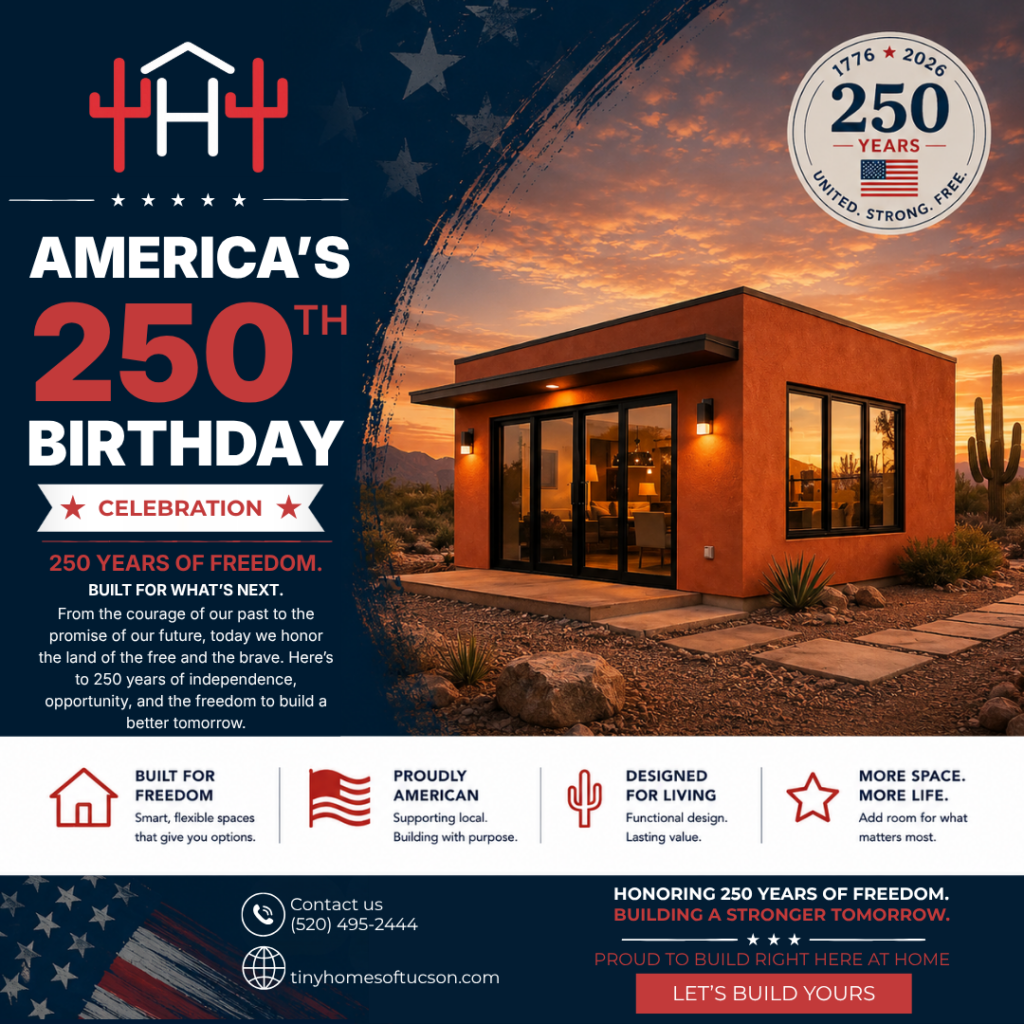
Built for freedom. Proudly American. Designed for living. More space. More life.
These aren’t just values we put on a graphic. They’re the principles behind every ADU we design and build. They’re the reason our clients call us after their project is complete to say that the backyard unit they weren’t sure about has become one of the best decisions they’ve ever made for their family, their finances, and their future.
America’s founders didn’t know exactly what they were building. They just knew it had to be built well, with good materials, clear purpose, and enough flexibility to last for generations. That’s still the standard worth aiming for — in governance, in community, and yes, in the structures we raise on the land we call home.
The Bottom Line for Tucson Homeowners
Tiny Homes of Tucson specializes in designing and building ADUs that are purpose-built for Southern Arizona — our climate, our zoning, our community, and our way of life. Whether you’re looking to generate rental income, house a family member, create more space for yourself, or increase the long-term value of your property, we’re ready to help you figure out what’s possible on your land.
If you’ve made it this far, you already understand something most homeowners don’t…
An ADU isn’t just a “nice-to-have” project. It’s a strategic move.
It’s how you create space without leaving your neighborhood.
It’s how you take care of family without sacrificing privacy.
And for a lot of people right now, it’s how you turn your property into something that actually works for you instead of just sitting there.
But here’s the part that trips most folks up…
All the rules, permits, zoning, and costs can feel like a mess if you try to figure it out on your own. And as you’ve seen, there are a lot of moving pieces involved, from zoning restrictions to utility connections to financing options .
That’s exactly why working with a local team matters.
Someone who already understands Tucson’s regulations.
Someone who knows what flies with permits and what gets rejected.
Someone who can look at your property and give you a straight answer instead of a guess.
👉 That’s where Tiny Homes of Tucson comes in.
They don’t just build ADUs. They help you navigate the entire process, from idea to move-in, without the usual headaches.
So instead of spending months second-guessing everything…
You can actually move forward with a plan that makes sense.
If you’re even thinking about adding an ADU, the smartest next step isn’t more research.
It’s getting clearer.
Talk to a team that’s already done this before, right here in Tucson.
Let’s build yours — right here at home, in the land of the free.
Happy 250th Birthday, America. Here’s to the next 250 years.
Tiny Homes of Tucson serves homeowners, families, and investors throughout the greater Tucson metropolitan area. We handle design, permitting, construction, and finishing — everything it takes to turn your backyard into something extraordinary.
Conclusion
Two hundred and fifty years is a long time. Long enough for a fledgling republic of thirteen colonies to become the world’s largest economy. Long enough for farmland to become cities, for dirt roads to become highways, for candlelight to become solar panels. America has always grown by building — and the best building has always been driven by purpose, not just ambition.
The ADU movement reflects some of the best impulses in the American character. It’s pragmatic: homeowners looking at underused backyard space and asking, what could this become? It’s community-minded: families choosing to stay close rather than scatter. It’s entrepreneurial: investors and property owners finding smart ways to generate value from assets they already hold. And it’s fundamentally optimistic — the belief that with the right plan and the right builder, something better is always within reach.
For Tucson specifically, the timing couldn’t be more right. Southern Arizona is growing. Housing demand is strong. The rental market is competitive. And city and state policies are more ADU-friendly than they’ve ever been. The window to act — to add a unit, generate income, house a family member, or simply expand your footprint — is wide open right now.
The four pillars we’ve explored in this post — Built for Freedom, Proudly American, Designed for Living, and More Space. More Life. — aren’t marketing slogans. They’re a framework for thinking about what a home can and should do for the people who own it. When your property gives you options, income, connection, and room to grow, it isn’t just real estate anymore. It’s a foundation for the life you actually want to live.
That’s what Tiny Homes of Tucson has been building toward, one project at a time. And as America marks this extraordinary 250th milestone, we’re proud to be doing it right here — in the Sonoran Desert, under the big Arizona sky, for families and homeowners who believe in building something that lasts.