

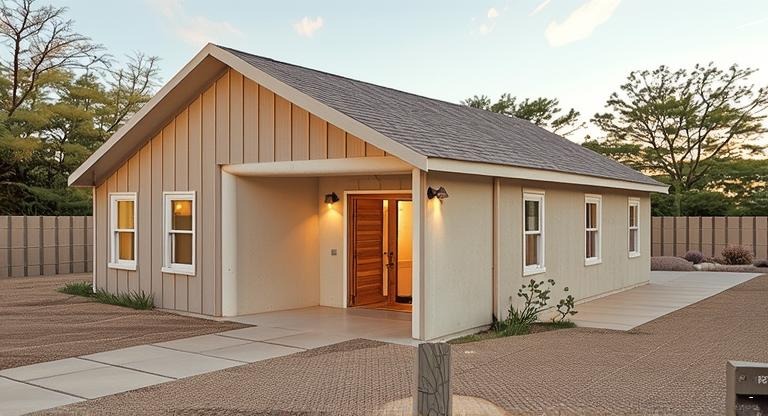
There is a quiet paradox at the heart of the housing conversation in the American Southwest. We are building more than we have in decades, trying to close a stubborn housing gap that has made communities across Arizona less affordable and less accessible for ordinary families. And we are doing it in one of the most ecologically sensitive and water-stressed environments on the continent.
Accessory dwelling units offer something rare in that conversation: a way to add housing that is, almost by its nature, more sustainable than the alternatives. Not because of any particular green feature or optional upgrade, but because of the fundamental logic of what an ADU is. A smaller structure. Built on land already developed. Close to where people already live, work, and shop.
For Tucson homeowners thinking about an ADU, the sustainability dimension is worth understanding clearly. In a city that averages 11 inches of rain per year, regularly records more than 100 days above 100 degrees Fahrenheit, and relies on a water supply that will only face more pressure in the decades ahead, building smart is not optional. It is the difference between a structure that performs well for thirty years and one that becomes expensive and uncomfortable to occupy after the first summer.
Why Small Buildings Are Inherently Greener
The most fundamental sustainability advantage an ADU has is its size. A typical detached ADU in Tucson ranges from 400 to 800 square feet. That is one quarter to one half the footprint of an average American home. And the environmental math of a smaller building is direct and significant.
Fewer building materials are consumed during construction. Less concrete, less lumber, less steel, fewer fixtures and finishes. The manufacturing and transportation of those materials represents a meaningful share of a new building’s total lifetime carbon footprint, and a smaller structure simply requires less of all of it.
The ongoing operating footprint is smaller too. A well-built 600-square-foot ADU requires far less energy to heat and cool than a 2,000-square-foot home, regardless of what systems are installed. The physics are favorable from the start. Less volume means less air to condition, less surface area through which heat can enter or escape, and a faster thermal response to whatever systems are managing the interior climate.
ADUs also make better use of land that is already developed. Rather than converting desert habitat or agricultural land at the urban fringe, they add housing capacity inside existing neighborhoods where roads, utilities, and services are already in place. The infrastructure cost, both financial and environmental, is shared across a larger base of residents, and the need to build new infrastructure at the edges is reduced.
The Desert Design Imperative
General sustainability principles apply to ADU construction everywhere. But building in Tucson’s Sonoran Desert adds a layer of specificity that matters enormously. The design choices that make a structure comfortable and efficient in a temperate climate are not the same ones that work here. Getting them wrong results in an ADU that is expensive to cool, uncomfortable in summer, and potentially short-lived as building materials degrade under prolonged heat stress.
The core challenge is solar gain. Tucson is sunny approximately 85 percent of the time, and the intensity of that sun during the peak summer months is relentless. A building oriented or glazed incorrectly will absorb far more heat than it should, driving up cooling loads dramatically. Conversely, a building designed with passive solar principles in mind can work with the desert climate rather than against it.
Passive solar design for Tucson means orienting the structure to limit western and southern glass exposure during peak summer hours, while using deep overhangs and roof overhangs to shade those windows during the hottest parts of the day. The same overhangs that block the high summer sun can be sized to allow the lower winter sun to enter and warm the interior naturally, reducing heating loads during Tucson’s mild winters. These are design decisions that cost nothing to implement during initial construction and pay dividends in comfort and utility cost for the entire life of the structure.
Thermal mass is another desert-specific consideration. Materials that absorb heat slowly during the day and release it gradually at night, including concrete, adobe, and rammed earth, are deeply embedded in Southwestern building tradition for good reason. They buffer the dramatic daily temperature swings that characterize the Sonoran Desert, keeping interiors cooler during the day and warmer at night without mechanical intervention.
Insulation, Ventilation, and Envelope Performance
A tight, well-insulated building envelope is the foundation of any sustainable ADU in Tucson. The goal is to minimize the transfer of heat between the interior and the intense exterior environment. High R-value insulation in walls, ceilings, and floors reduces how hard the cooling system has to work, which directly reduces energy consumption and utility costs for whoever is living in the unit.
Spray foam and rigid foam board are both common choices for desert ADU construction because they provide high R-values per inch and seal gaps that allow air infiltration, which is a significant source of energy loss in any building. Air leakage can account for a substantial share of a home’s total energy loss, and in a climate where outdoor air is frequently 40 or 50 degrees hotter than the desired indoor temperature, every gap matters.
Ventilation must also be addressed carefully. Cross-ventilation, positioning windows and vents on opposite sides of the structure to allow air movement, is effective during Tucson’s cooler evenings and shoulder seasons. During monsoon season, when outdoor humidity rises, mechanical ventilation becomes more important to manage moisture and maintain indoor air quality. A well-designed ADU incorporates both passive and mechanical options so the occupant can manage the space efficiently through all of Tucson’s seasonal variations.
Energy: Solar Power in the Sunniest City in America
Tucson receives more annual sunshine than virtually any other major city in the United States. That is an environmental liability when it comes to cooling load. It is an extraordinary asset when it comes to solar energy generation.
A solar photovoltaic system on an ADU roof can generate enough electricity to fully offset the unit’s energy consumption, and in some configurations, produce a surplus that is fed back to the grid. For an ADU that is being used as a rental unit, a solar-powered structure with low utility bills is a significant competitive advantage in the rental market. Tenants increasingly expect and seek out energy-efficient housing, and a unit that runs on solar power commands both higher rent and lower vacancy.
Ductless mini-split systems are the heating and cooling technology of choice for sustainable ADU construction in Tucson. They are significantly more efficient than central forced-air systems, they allow precise zone control so that only occupied spaces are conditioned, and they work with high-quality insulation rather than compensating for poor envelope performance. A mini-split combined with good insulation and passive solar design produces a structure that is both comfortable and genuinely low-energy in operation.
Water: The Most Critical Resource in the Sonoran Desert
In a city that receives 11 inches of rainfall annually and draws water from a basin under increasing pressure from population growth and a drying climate, water conservation is not a lifestyle preference. It is an ecological and civic responsibility.
Sustainable ADU construction in Tucson addresses water at two levels. Inside the unit, low-flow fixtures including faucets, showerheads, and toilets reduce consumption without compromising function. Tankless water heaters eliminate the standby energy loss of storage tanks and deliver hot water on demand, reducing both energy and water waste.
Outside the unit, landscaping choices have the largest impact. Traditional turf landscaping in Tucson can use 50 to 75 percent more water than a well-designed xeriscape. A native desert landscape around an ADU, using plants like saguaro, palo verde, agave, and desert willow that have evolved to thrive on Tucson’s rainfall patterns, requires no supplemental irrigation once established. Passive rainwater harvesting, shaping the ground around the structure to direct runoff into planting basins, captures and infiltrates the limited rainfall the city does receive, keeping it on site rather than losing it to runoff.
Materials and Construction Practices
The materials used to build an ADU carry their own environmental footprint from extraction through manufacturing and transportation to the site. For Tucson homeowners who care about sustainability, material choices are worth discussing with a builder.
Locally sourced materials reduce transportation energy and support regional economies. Adobe and rammed earth, traditional Southwestern building materials, are locally available, have excellent thermal mass properties, and produce structures with strong cultural resonance in the Tucson landscape.
Low-VOC paints and finishes reduce the volatile organic compounds that off-gas into interior air after construction. In a smaller space like an ADU where the volume-to-surface-area ratio is higher than in a large home, material off-gassing has a proportionally greater impact on indoor air quality.
Recycled and reclaimed materials for decking, framing, or finish work reduce demand for new resource extraction. A builder experienced in sustainable construction will have established supplier relationships that make these choices accessible without significant cost premium.
The Bigger Picture: ADUs and Tucson’s Housing Future
Individual sustainable design choices matter. But the broader sustainability argument for ADUs in Tucson operates at the community scale.
Every ADU built inside an existing neighborhood is a home that does not need to be built at the urban fringe. It does not require new road construction, new utility extensions, or conversion of desert land to developed use. The residents who live in it are, by definition, in proximity to the services and infrastructure of an established community, which means less driving, less transportation energy, and a lower per-person environmental footprint than residents of new developments at the edge of the metro area.
Tucson is a city with strong sustainability values and a long tradition of desert-adapted architecture. Building ADUs that reflect those values, structurally, mechanically, and in terms of material and landscape choices, adds housing that the city needs while honoring the ecological context that makes the Sonoran Desert one of the most distinctive and important landscapes in North America.
For homeowners who want to build an ADU that is designed for this climate from the ground up, the starting point is a conversation with a builder who actually understands Tucson’s conditions.
Tiny Homes of Tucson offers free site visits for homeowners across the metro area, covering what your lot can support, what sustainable design options make sense for your property and goals, and what a complete, honest build estimate looks like. It is the fastest way to move from general interest to a real plan built for the desert you live in.