

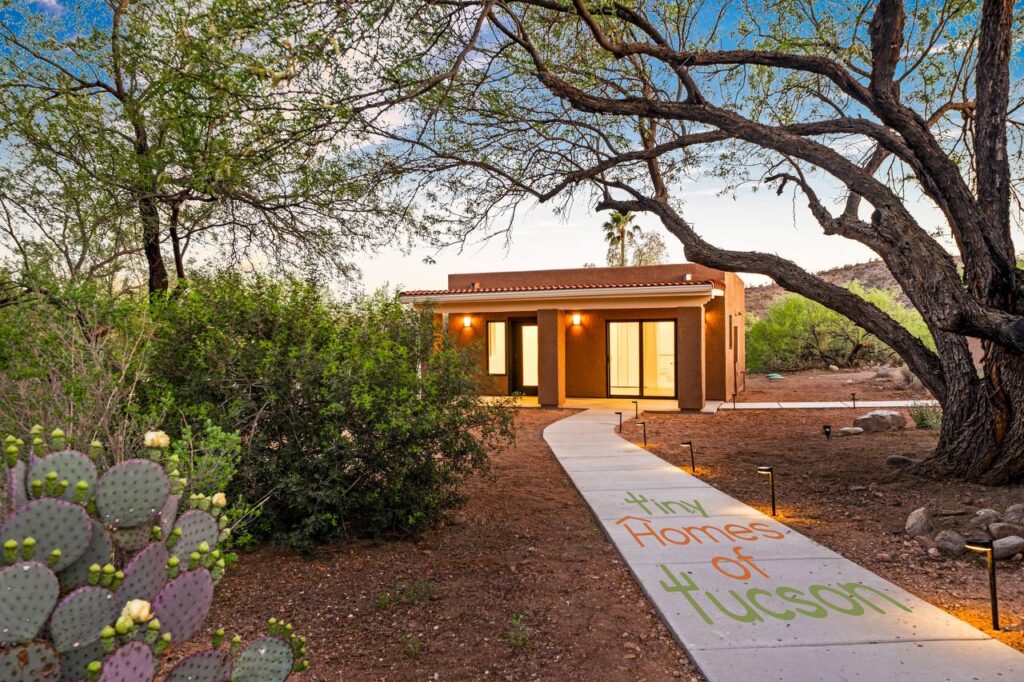
A conversation happening in Wall Street boardrooms and Washington policy offices right now has a direct connection to the backyard behind your house. Tiny homes and accessory dwelling units, once considered a fringe idea for minimalists and eco enthusiasts, are now being described by investors, economists, and housing policy experts as one of the most practical tools available to address the United States housing shortage.
A recent report from Semafor, featuring the CEO of Samara, a housing startup that spun out of Airbnb in 2022, put a sharp point on the conversation. The argument being made at the highest levels of finance and real estate is simple: prefabricated homes that fit in existing backyards can solve two of the most stubborn problems in the American economy at once. The shortage of housing units and the shortage of income-generating assets for everyday investors.
For Tucson homeowners, this national conversation is not abstract. It is happening right here, in cities like yours, on lots just like yours. And understanding what is driving it can help you make a smarter decision about what to do with the space behind your house.
What the National Conversation Is Really About
The Semafor piece centers on a fundamental observation about how Americans think about property. Banks and lenders have spent decades building systems to finance the front of your property, the primary home, the mortgage, the appraisal process. They know exactly how to assign value to it, lend against it, and package those loans for investors.
The backyard is a different story. Until very recently, there was no established financial infrastructure around it. No standard loan product. No widely recognized asset class. No consistent way for a homeowner to unlock the value sitting behind their house.
That is starting to change. Mike McNamara, CEO of Samara, put it directly in the Semafor interview: banks “understand the mortgage of the front yard very well. We’re trying to create a different asset class” in the backyard. His company is already offering 100 percent financing for ADU builds to homeowners who have sufficient equity in their primary home, and he pointed to Fannie Mae and Freddie Mac’s recent move to begin recognizing ADU rental income when evaluating primary mortgage applications as an early sign of where the financing landscape is headed.
The comparison he draws is to rooftop solar. Solar installations were once difficult to finance because lenders did not know how to evaluate them. Once the income stream from energy savings became predictable and documentable, the financing followed. ADUs are following the same arc.
The Numbers Behind the Momentum
The growth in ADU permit applications tells a clear story about how quickly this market is moving. In California, one of the most closely watched ADU markets in the country, applications grew from roughly 2,000 in 2016 to 30,000 in 2024. That is a fifteenfold increase in under a decade, driven primarily by the easing of zoning restrictions that previously made ADU construction difficult or impossible in many jurisdictions.
Arizona has been on a parallel track. The state’s 2022 legislation limiting municipal restrictions on ADU construction opened the door for far more homeowners across Tucson, Phoenix, Scottsdale, and surrounding communities to build. The practical effect is that properties that could not support a legally permitted secondary unit a few years ago may now qualify under the updated regulatory framework.
Samara reports that approximately half of its customers in southern California rent out their ADU units after construction. In northern California, the more common use case is housing aging parents or other family members in what are often called in-law suites. Both uses reflect real demand in the market, and both generate value for the homeowner in different ways.
What This Means for Tucson Specifically
Tucson is not California, and the ADU dynamics here are not identical. But the underlying forces are the same. Housing inventory in the Tucson metro area has remained tight for several years. Rental demand from university students, young professionals, and relocating families from higher-cost cities has kept occupancy rates high and rents elevated. At the same time, Tucson home values have appreciated meaningfully over the past decade, which means many long-term homeowners are sitting on substantial equity.
That combination, tight rental demand plus significant home equity, is exactly the setup that makes an ADU build financially compelling. A homeowner who can leverage existing equity to finance construction and then generate $1,000 to $1,500 or more per month in rental income is creating a compounding financial asset on land they already own.
The multigenerational use case is equally relevant here. Tucson has a large and growing population of retired and semi-retired homeowners whose parents are reaching ages where some level of proximity and support becomes important. An ADU built for an aging parent is not a rental income play, but it is a cost-avoidance play. Assisted living facilities in Arizona can cost $4,000 to $6,000 per month or more. A well-designed ADU that keeps a parent close and independent can eliminate that cost while also adding to the property’s long-term value.
The Financing Gap and How It Is Closing
One of the most honest observations in the Semafor piece is that financing an ADU is still not easy. Unlike a primary home purchase, there is no standard ADU mortgage product that a homeowner can walk into a bank and apply for. Most ADU builds today are financed through home equity lines of credit, cash-out refinancing, personal loans, or, in Samara’s case, direct lending by the builder.
This is the current friction point in the market, and it is real. But the direction of travel is clear. Fannie Mae and Freddie Mac’s recognition of ADU rental income in primary mortgage underwriting is a meaningful first step. It signals that the secondary market, where mortgages are bought and sold, is beginning to assign value to ADUs as productive assets rather than simply square footage additions.
For Tucson homeowners, the practical implication is this: if you have equity in your home, you likely have more options to finance an ADU build than you realize. A conversation with a lender and a qualified ADU builder can clarify what financing paths are available to you based on your specific property and equity position. The landscape is more accessible than the absence of a standard product might suggest.
The Investor Angle and Why It Matters to You
The Semafor piece frames ADUs partly as an investment product, noting that Wall Street’s appetite for income-generating assets makes ADU loans attractive to institutional capital. This might feel distant from a Tucson homeowner’s daily concerns, but it has a practical consequence worth understanding.
As more institutional capital flows into ADU financing, the cost and availability of that financing for individual homeowners tends to improve. The solar analogy is instructive again. When institutional investors began buying solar loan portfolios in bulk, the terms available to individual homeowners became significantly more favorable. The same dynamic is likely to play out with ADU financing over the next several years.
For a homeowner who is thinking about building an ADU but waiting for the financing options to improve, there is a real cost to that wait. Every month without a built unit is a month without rental income, or a month paying for elder care that an ADU could have replaced. The homeowners who move now are building equity and income streams while the financing landscape is still developing. Those who wait for perfect conditions may find themselves entering a more crowded, more expensive market.
What Makes a Good ADU Investment in Tucson
Not every backyard is an equally good candidate for an ADU build, and not every ADU will generate the same return. The factors that determine whether a build makes financial sense for a specific property include:
- Lot size and setbacks. Tucson’s zoning codes specify minimum distances between structures and property lines. A smaller lot may still qualify for an ADU but will have design constraints that affect the size and layout of the unit.
- Existing utilities and site access. Units that can connect to existing water, sewer, and electrical infrastructure cost less to build than those requiring new connections. A property with good rear yard access for construction also reduces site preparation costs.
- Neighborhood rental demand. Some parts of Tucson command stronger short-term rental rates due to proximity to the University of Arizona, downtown, or major employers. Long-term rental rates tend to be more consistent across the metro area but still vary by neighborhood.
- Design for the intended use. An ADU designed primarily for rental income will prioritize different features than one designed for a family member. Getting the design right for the intended purpose from the beginning avoids costly modifications later.
A qualified ADU builder with experience in Tucson will be able to assess all of these factors during an initial property visit and give you a realistic picture of what your specific lot can support and what the expected return looks like.
The Bottom Line for Tucson Homeowners
The national conversation about tiny homes and ADUs is not a trend story about alternative lifestyles. It is a conversation about housing supply, investment returns, and the practical choices available to homeowners who are sitting on valuable land they are not fully using.
The Semafor piece captures the moment accurately. The zoning barriers that made ADU construction impractical in most of the country are coming down. The financing infrastructure is developing, slowly but visibly. And the demand, from renters, from aging parents, from investors looking for yield, is real and growing.
Tucson homeowners are well positioned to act on this. The regulatory environment in Arizona is more favorable than it was three years ago. Home equity levels across the metro are strong. Rental demand remains healthy. And the cost of building a quality ADU, while not trivial, is substantially lower than the value it can generate over a ten or twenty year horizon.
If you have been thinking about whether your property could support an ADU and what it would realistically cost and return, the most useful next step is a property-specific conversation rather than continued general research.
Tiny Homes of Tucson offers free site visits for homeowners across the Tucson area, covering zoning eligibility, design options, and a clear all-inclusive estimate. It is a straightforward way to find out whether your backyard is ready for what the rest of the country is starting to figure out.